Tamate: A Drum of the People
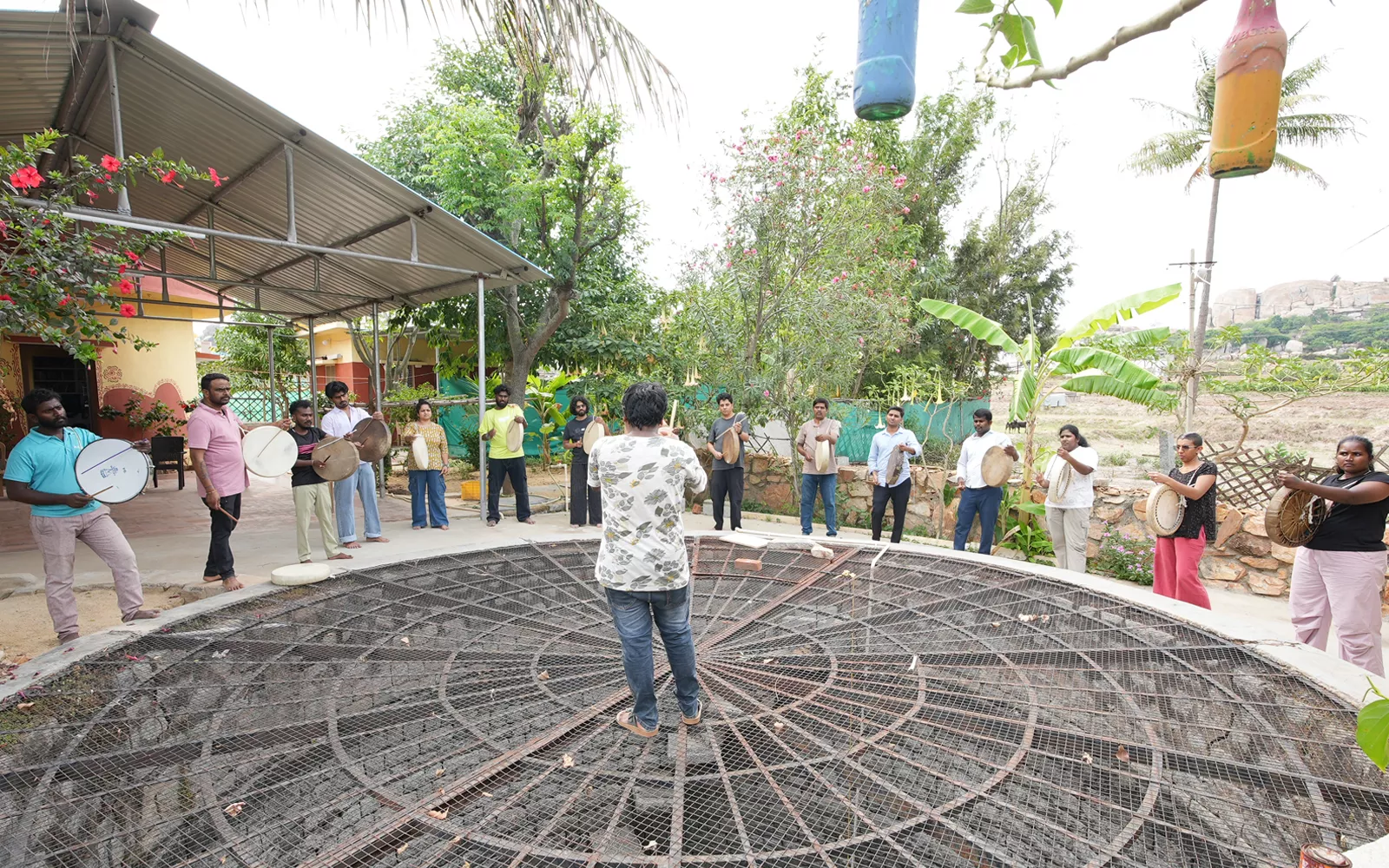
A lecture-demonstration and drum circle with Bharath Dingri and Halgi Culture
29 August | 4 to 5 PM: Lecture-demonstration | 5:30 pm: Drum Circle
IMPORTANT: The lecture-demonstration will primarily be in Kannada with an English interpreter present to help audiences.
In India, hierarchies of caste seep into everything, including the world of musical instruments.
When we think about Indian music, we think about the tabla, mridangam, harmonium, veena, sitar or flute upon formal stages and within proscenium spaces. But, instruments like the Tamate, Choudki, Dudi, Gane, Are, Dimbu and Kani that are often associated with communities, rituals, streets, villages and spaces outside the mainstream, do not receive similar popular acknowledgement.
This also means that we often neglect the knowledge and labour of historically and structurally marginalized communities that have been central to making instruments: working with leather, creating musical objects, and sustaining various cultural and ritual practices.
Through this lecture-demonstration Bharath Dingri raises some important questions through the story of the Tamte, a traditional hand-drum from Karnataka that has historically been treated as “untouchable” due its association with communities that work with leather and perform funeral rites :
Why are some instruments given a place inside the proscenium while others are kept outside it?
Why are some forms of musical knowledge recognised as “classical”, while the knowledge of communities who make, play and sustain other instruments is not recognised as skill or knowledge?
And why are communities not given ownership and credit for their knowledge, labour and cultural practices?
According to him, “When we touch the Tamate without discrimination, the skin of the drum accepts us. We can then touch it, play it, listen to it and create music with it.”
Ultimately, the lecture explores the relationship between caste, musical instruments, cultural knowledge and power. We invite audiences to look at how musical instruments are not merely objects that produce sound, but also carry histories, identities and politics.
But it is not just knowledge that we want to share, but the joy and vigour of playing the Tamate. Which is why the lecture-demonstration will be followed by a Tamate drum circle, where audiences of all ages can get their hands on the instrument and raise the rhythm with the drummers of Halgi Culture.
About the Artist:
Bharath Dingri
Bharath Dingri is a folk arts educator, theatre practitioner, musician and the founder of Halgi Culture, a Bengaluru-based collective dedicated to reclaiming the tamate (halgi) and foregrounding Dalit-Bahujan musical traditions and aesthetics.
Originally from Ashapura in Raichur district, Karnataka, Bharath grew up accompanying his father, a street-play artist, and began playing the tamate from a young age. He went on to train at Ninasam Theatre Institute and holds a diploma in journalism. His work spans theatre, music, performance and cultural education, with a particular focus on the histories and politics embedded in folk forms.
Through Halgi Culture, Bharath conducts workshops and performances that explore the tamate not simply as a percussion instrument, but as a powerful expression of Dalit identity, memory and resistance. His approach combines learning the instrument with conversations around Dalit culture, anti-caste movements and the histories of labour associated with the tamate. He has also developed an accessible system of notation for teaching the instrument.
Bharath was part of the acclaimed theatre production Daklakatha Devikavya, for which he received the Mahindra Excellence in Theatre Awards (META) for Best Supporting Actor. His recent work continues to bring the tamate into contemporary performance spaces, inviting new audiences to listen to—and engage with—the instrument on its own artistic and cultural terms.
Date and time:
29 August 2026, Saturday
04:00 – 05:00 PM: Lecture-demonstration
05:30 pm: Drum Circle
Register here:
Click Here